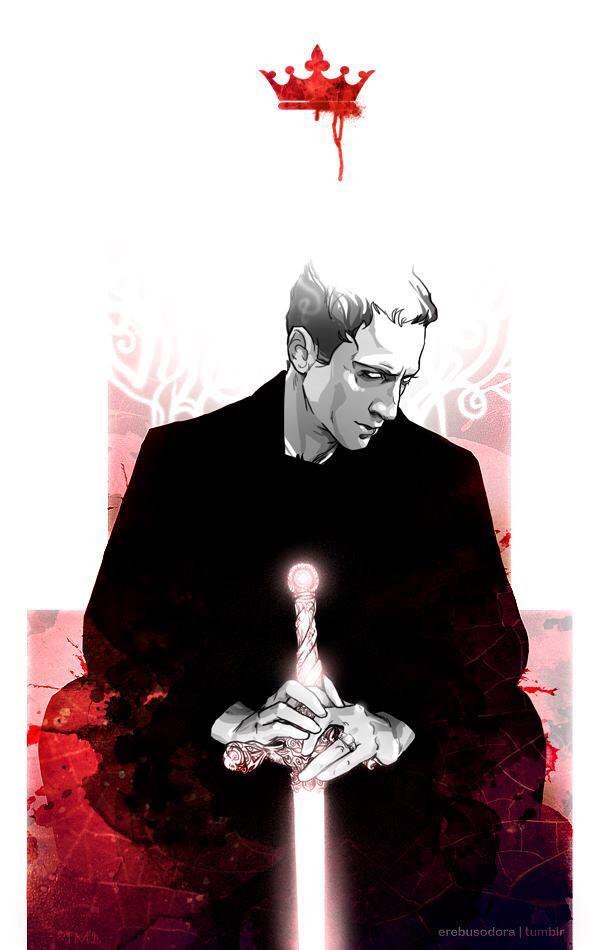
“You need to understand your place in all this. If you and I could overcome our differences, we will make history.” – Renard
“You need to understand your place in all this. If you and I could overcome our differences, we will make history.” – Renard




Grimm + Pokemon Go Teams: Team Mystic
“CHERISH THOSE WHO SEEK THE TRUTH BUT BEWARE OF THOSE WHO FIND IT.”
To answer this question I feel like it’s important to remember that Sean’s mother did raise him and probably knows her son better than anyone else. So she may be the least surprised person by his choices. In fact, he may have learned the things that led to those choices directly from her.
I’d also hesitate to call Sean “full on evil” at this point, or to say that he’s throwing his mother’s sacrifices away purely for the sake of power. First, it’s pretty clear to me that while power may be Sean’s goal, he doesn’t want power for power’s sake. There’s a long and complicated history there, much of which Sean has felt relatively powerless.
It’s also important to note that the single thing which seemed to turn Sean from a reluctant half-participant in Black Claw’s machinations to a full on company man? Was not the promise of power, but the moment they reunited him with Diana–the daughter he was powerless to protect once before. They were promising him power from the start, but it wasn’t until they put Diana in front of him that he got on board with their plans. So I think it’s pretty clear that for Sean, power is a means to an end: protecting himself and his loved ones.
As for the other part of that, he is definitely a full-on antagonist in a way he’s never been before now, but evil? Thus far in his stint with Black Claw he’s done nothing more gruesome or horrible than he’d done in any previous season, and he’s arguably killed fewer people than Nick by a lot. The only difference is that now he’s doing these things to characters we like.
Most of the time, this show’s antagonistic characters aren’t evil so much as they are suffering, and lashing out in one way or another due to that suffering. Many times there are extenuating circumstances that explain their actions, and/or they are not in control of their actions at all for one reason or another. So I would really hesitate to label most of the previous antagonists morally evil in a show which has never clearly defined its internal morality with any level of consistency, and which sets the morality bar for its heroes somewhere around charcoal gray.
Sean in particular has always struck me not as evil, but as shrewd, calculating, cautious, and ultimately self-serving. He does what he has to do to protect himself and his own, which is something I think Elizabeth would understand easily, even if she disagreed with his way of going about it.
So TL;DR: I feel like we’d have to have a much bigger discussion about the nature of moral good vs. evil and where that value judgment comes from–the action itself, the spirit or motivation behind it, the intended result, the actual immediate result, or the reverberating consequences, not to mention whether it’s actually a choice being actively made or simply the only possible or perceived possible action–before stamping Sean or any other character on the show with “evil.” And to be honest, I’m not sure I have the philosophical training required to outline the necessary parameters of that conversation, much less tackle the conversation itself.
The further I get into my rewatch of season one for the Grimm Stats, the more early signs I see of Renard eventually turning out the way he is at the end of season 5. And I don’t want to believe it, because I still hate that it feels like none of the friendship and character development we’ve seen with him and the team the last three years has been real. But at the same time, I’m beginning to consider that it isn’t so simple. Perhaps it’s not so much that Renard’s friendship with the team wasn’t “real” as that it wasn’t as important as what Black Claw was offering.
In “Last Grimm Standing,” Renard goes to a severely creepy priest to get “justice” meted out toward Leo Taymor. And before they part ways, they say “as it was before, so shall it be again.”
Now on the surface he’s just paraphrasing Ecclesiastes 1:9 to a priest, but in the context of everything that happened after and everything we know about Renard’s life, maybe it’s more than that.
Taken with everything else we know, it seems like at his core, Sean Renard longs–and has always longed–for a return to “days of yore.” Perhaps not in the way most people would think of that phrase, but in a personal sense: a return to the security he felt as a child, to a world that treated him a certain way and afforded him certain things. But he wants it to happen in a very specific way: one that would recognize his importance as both a royal and a zauberbiest, without pitting one side against the other or demanding he limit himself in any way for the benefit of humans. In short, one that allows him to be powerful. Because power is what he values most.
Renard learned from a young age that loyalty, family, and friendship are conditional and changeable. On the whim of the queen, his life became forfeit at the age of thirteen, and he and his mother had to flee everything they knew and loved in order to survive. In his experience, no amount of affection or sentimental attachment can stand up in the face of power. Is it any wonder he would choose power over friends?
That’s why he wants the keys: they promise ultimate power. That’s why he wants the coins, too. And ultimately, that’s why he wants Nick on his side so badly: a Grimm is a powerful ally, and the more Nick proves himself a friend of Wesen and someone that Wesen respect and even like, the more powerful an ally he has the potential to be.
Power. Leverage. Common end goals, however temporarily. That’s why Renard aligns with Team Grimm, the Laufer, and Black Claw but not with the Royals, the Wesenrein, the Verrat, the Wesen Council, or Hadrian’s Wall. All five of those latter groups seek, from their perspectives, to preserve something. But none of them would benefit Renard in the end.
The Wesenrein would find him abhorrent. They wish for a return, to a (probably mythical) time of “Wesen purity,” and would view Renard’s very existence (to say nothing of his child’s) as an affront to that goal.
Hadrian’s Wall, the Royals, the Verrat, and the Wesen Council, on the other hand, are all dedicated to maintaining the current status quo in various ways. The Royals want to retain their power, and they shunned Sean as a child for being half-zauberbiest and a bastard. The Wesen Council want to maintain the secrecy of the Wesen world, which limits Renard’s ability to gain power and mobilize against his enemies. The Verrat are mostly just tools the Royals use to achieve their goals, and they only grudgingly acknowledge Renard’s limited authority. Hadrian’s Wall primarily fights to keep Black Claw at bay, thus preserving Wesen secrecy and limiting the rise of a significant Wesen institution that would upset the existing balance of power.
But Team Grimm? Everything about them flouts the rules and expectations of the Wesenrein, the Royals, the Verrat, and even the Wesen Council. He watches for over a year as Nick helps Wesen who are innocent and tries, as much as possible, to deal with those who aren’t within the confines of human law. He can’t help but note Nick’s friendship with Monroe and Rosalee, and their growing romantic relationship besides. And he realizes, when he finally reveals the truth of himself to them, that they mistrust him primarily because he’s done shady things, not because of who or what he is. To put it simply, they accept him. And that acceptance, while not a goal in the same way that power is a goal, is something that Sean Renard craves.
We see it in “Three Coins in a Fuchsbau”: Renard wants power, yes, but he also wants recognition, and adoration. He wants people to listen to him and follow him. He wants them to respect him, and yes, to love him. And none of those things are ever going to be gained if he isn’t first accepted. The team accepts him. And his bond with them, though tenuous at first, is truly based on trust, friendship, and mutual affection. He cares about them and appreciates that they care for him. The events of seasons three and four clearly show that this is the case.
His alliance with the Laufer is relatively brief, and much more tenuous. They could never be true, long-term allies because they mistrust his human side as much as the Royals mistrust his zauberbiest side. They are also suspicious of his motives, as he is of their methods. But at the end of the day, they have common goals–at least for the moment. So he works with them to achieve those goals, and then they go their separate ways in peace.
Finally, we have Black Claw. They come to him in season five and offer him everything he has ever wanted: acceptance, power, recognition, public adoration…and his daughter, back with him at last, safe and sound. He goes reluctantly, at first–he knows Nick and the team won’t like it, and I think he also knows they won’t follow–but go he does. As important as they may be to him, Team Grimm can only offer him friendship, and that is (sadly) not enough for Renard in the grand scheme of things. Not when Black Claw is offering him everything else.
Perhaps he tells himself he has no choice. Maybe he thinks he can eventually make other friends…or that some of them may yet change their minds when they see that Black Claw’s success is inevitable. He hopes for it enough, at least, to try and convince Nick to join him. But when it comes down to it, if he can’t have both, he’s going to pick the one offering him the thing that his experience says cannot be broken or threatened so easily.
Because sure, friends may be nice to have to a point, but at the end of the day, he also sees them as a potential weakness. After all, as he told Adalind in “Island of Dreams”: The way to a man’s soul is through his friends.


Grimm + Eaglecrest Houses, Part I: Bluthyonce
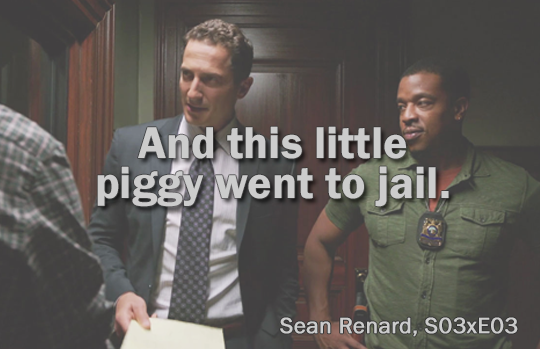
“And this little piggy went to jail.” – Sean Renard, S03xE03
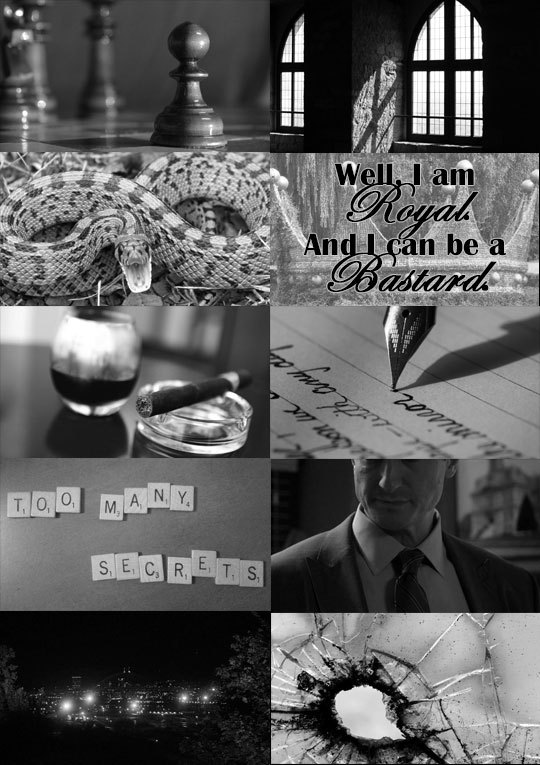
Grimm Aesthetic: Sean Renard










First & Last Appearances By Season: Sean Renard
Here’s hoping!
And this Renard fan is really, really hoping that he had his brains messed with by Bonaparte or Diana, and that this recent characterization is not a total fail on behalf of the writers.
If we have to have evil!Sean, I would like him to have brains and a damn spine, like you say.
Have you read the comic Renard’s Reckoning? It’s almost the same story, except Renard kills the gang boss out of his own free will and takes control of the city in the most epic way.
That comic is how this storyline should have gone down, and I think it was the inspiration for it as Renard also kills a ‘friend’ to further his own ends.
(And I assume you mean Conrad Bonaparte, not Sebastien. Sebastien was one of Renard’s ‘friends’ who was killed by Viktor whilst he and Meisner were trying to get Adalind and Diana out of Austria.)








 FYeahNickBurkhardt (Tumblr Backup)